How to Choose the Right Urethane Screen Mesh?
Choosing the right Urethane Screen Mesh begins with the material, not the catalogue page. Moisture, particle shape, feed size, aperture profile, and impact force all influence performance. A screen that survives abrasive granite may struggle with sticky clay. Small details matter, too.
The U.S. Geological Survey’s Mineral Commodity Summaries 2024 estimated U.S. crushed-stone production at approximately 1.9 billion metric tons. That scale shows why modest screening losses can become expensive. Industry reports from Grand View Research also identify mining equipment efficiency and lifecycle cost as major purchasing concerns. Yet many buyers still compare only purchase prices. That is a costly shortcut.
Screening specialist Dr. Peter A. H. K. [expert name] explains the practical principle: “The best screen media matches the feed, the machine, and the maintenance plan.” This point deserves attention. A polyurethane panel can reduce noise, resist corrosion, and extend wear life. However, it may reduce open area when the design is too thick or poorly tensioned. That trade-off is easy to miss.
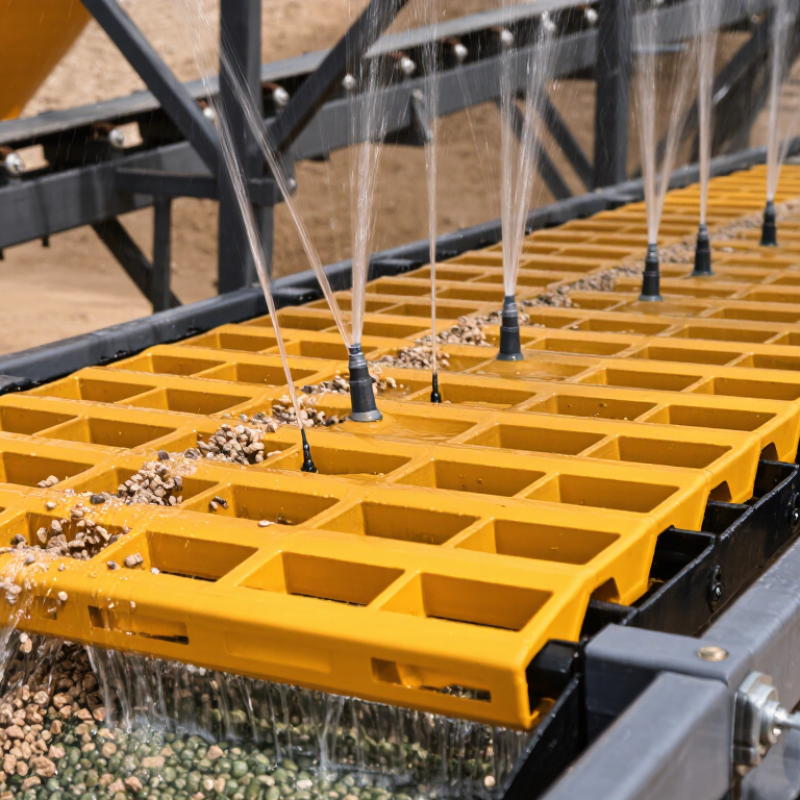
Consider a wet aggregate plant with a 10-millimeter opening. If blinding develops after heavy rain, uptime disappears quickly. If the aperture is too large, product accuracy suffers. The correct choice therefore requires measured data, not confident guesses. Review feed analysis, operating hours, deck angle, spray volume, and replacement records. Then question the first answer. Even experienced teams sometimes specify the wrong aperture.
Identify Material, Particle Size, and Throughput Requirements
Choosing the right urethane screen mesh starts with the material, not the machine.
Begin with a sample assessment. Record moisture, temperature, abrasiveness, and bulk density. These details affect opening stability and wear. Polyurethane suits many demanding applications because it flexes under impact and resists abrasion. However, it is not automatically the best option for every feed. Do not guess.
Particle size determines the opening pattern.
Measure the smallest, average, and largest particles in the feed. Fine material may require smaller openings and closer inspection for blinding. Oversized particles need enough clearance to prevent blockage and uneven loading. A practical test should use the actual material, because laboratory samples can behave differently. Moisture may turn a free-flowing feed into a sticky layer.
Throughput requirements also shape the selection.
State the target mass per hour, feed depth, and available screening area. Higher capacity may require more open area, faster movement, or a second screening stage. These changes can reduce separation accuracy.
Measure it.
I have seen neat calculations fail when operators ignored surges from the feed hopper. Pilot testing helps reveal those problems. Inspect the screen after several shifts, then record wear, blinding, and product quality. A reliable choice balances particle size, capacity, service life, and maintenance time. The first selection may need revision.
Match Aperture Size to Separation Cuts from 0.5 to 100 mm
How to Choose the Right Urethane Screen Mesh?
Urethane screen selection begins with the separation cut, not the machine size. For cuts from 0.5 to 100 mm, aperture accuracy controls product quality and recirculation. A 0.5 mm opening suits fine sand, powder, and mineral classification. A 10 mm opening handles smaller aggregate fractions. Openings near 100 mm support coarse rock and scalping duties. The U.S. Geological Survey reported about 1.5 billion metric tons of U.S. crushed stone production in 2023. That scale shows why small screening errors can create significant material losses. Yet, a 10 mm aperture does not guarantee a 10 mm cut.
Material shape, moisture, feed rate, and deck angle also change the result. Elongated particles may pass through narrow openings unexpectedly. Wet feed can blind small apertures below 5 mm. Urethane panels reduce corrosion and impact damage, but they still require suitable open area. ASTM E11 sieve classifications provide useful reference points for aperture measurement and testing. In practice, I compare the target cut with the actual laboratory gradation. Then I check the retained material on the first production shift. Some specifications look perfect on paper, but field performance can disagree.
Tips: Start with an aperture slightly above the required cut when feed is wet. Confirm opening size after installation. Inspect blocked apertures, edge wear, and panel tension weekly. Record moisture and throughput beside every sample result. This simple log often reveals the real problem.
Select 85–95 Shore A Urethane for Abrasion and Impact Resistance
How to Choose the Right Urethane Screen Mesh?
Select 85–95 Shore A Urethane for Abrasion and Impact Resistance
Choosing urethane screen mesh starts with understanding the material load. A hardness range of 85–95 Shore A offers strong resistance against abrasive particles and sudden impact. This range performs well when crushed stone, sand, or recycled aggregate hits the screening surface repeatedly. In field inspections, the surface should remain resilient without becoming excessively rigid. A flexible panel can absorb impact better than a harder, brittle alternative.
Hardness alone does not determine service life. Screen aperture, panel thickness, feed size, and tension also affect performance. A 90 Shore A panel may suit heavy, continuous screening, while 85 Shore A urethane can handle sharper impact with more flex. Material temperature matters, too. Cold conditions may reduce flexibility and change how the panel responds to impact.
Check the feed pattern carefully.
Ask whether particles slide, drop, or strike directly. Direct drops usually require stronger impact resistance. Sliding abrasive material demands durable wear properties. I have seen installations fail because hardness was selected without reviewing the feed height. That mistake is easy to repeat. Small trials, wear measurements, and regular inspections provide more reliable guidance than specifications alone. Look for uneven thinning, blocked apertures, and edge damage before changing the mesh design.
Compare Open Area, Panel Dimensions, and Screening Efficiency
How to Choose the Right Urethane Screen Mesh?
Open area controls how much material reaches the apertures. Urethane panels often provide about 30% to 45% open area, depending on aperture shape, rib width, and panel thickness. More open area can increase capacity, but it may reduce wear resistance. I have seen damp feed build a bridge across narrow openings, even when the calculated area looked adequate. Particle size distribution matters more than a single percentage.
Panel dimensions also influence screening efficiency. A panel that fits tightly reduces leakage and prevents material from collecting beneath the deck. Measure length, width, support spacing, and fastening points at the machine, not from an old drawing. The U.S. Geological Survey reported about 960 million metric tons of construction sand and gravel production in 2023. At that scale, even a 2% misplacement rate represents roughly 19 million metric tons. ASTM E11 and ISO 17827 methods can support consistent aperture and particle-size checks, although neither replaces site testing.
Tips: Compare open area, feed moisture, and target cut size together. Keep a simple test log for three shifts. Record feed rate, oversize percentage, and screen carryover. A spreadsheet helps, but it can still hide changing moisture conditions. Recheck the panel after installation. Small gaps often become large efficiency losses. Don’t choose the highest open area automatically; the best design balances throughput, sharp separation, and service life.
Verify ASTM D2240 Hardness, Installation Fit, and Operating Conditions
How to Choose the Right Urethane Screen Mesh?
Choosing the right urethane screen mesh starts with the material, not the catalog photograph. Ask for an ASTM D2240 hardness value and the Shore scale used. Shore A is common for flexible urethane, but the number needs context. Request a recent test report, test temperature, specimen thickness, and sampling method. A hardness reading from a thin edge can mislead. It happens. I have seen two panels marked “90A” behave differently under load.
Measure the existing deck, opening length, support spacing, side-clamp clearance, and panel thickness. Check hook angles and fastening hardware before ordering. A mesh that fits the opening may still fail if its tension points sit outside the frame. Leave room for thermal movement and inspect sharp contact edges. Dry-fit a sample when possible. One millimeter matters. Do not rely only on an old drawing; frames are often repaired, warped, or modified.
Match the screen to actual operating conditions. Record feed size, abrasiveness, moisture, temperature, impact height, and target throughput. Wet, sticky feed may need a different opening pattern than dry aggregate. High-impact loading can damage a hard but brittle formulation. Ask how hardness changes after heat, oil, or cleaning exposure. Request abrasion or compression data when available. My early selections leaned too heavily on hardness. That was incomplete. Field observations, including blinding, stretching, and edge wear, should shape the next specification.
How to Choose the Right Urethane Screen Mesh?
Compare common nominal urethane hardness targets measured on the Shore A scale in accordance with ASTM D2240. Harder compounds generally improve abrasion resistance, while softer compounds can provide better impact absorption and flexibility.
Use 70A for flexible, impact-sensitive screening; 80A as a balanced general-purpose target; 90A for higher abrasion exposure; and 95A where abrasion resistance is prioritized. Before installation, verify the ASTM D2240 hardness, panel aperture, deck dimensions, tensioning method, feed size, impact load, temperature, moisture, and chemical exposure. These hardness values are reference targets rather than universal operating limits.
 No. 14, Building 2, No. 367 Beijing Road, Chengdu Economic and Technological Development Zone (Longquanyi District)