No. 14, Building 2, No. 367 Beijing Road, Chengdu Economic and Technological Development Zone (Longquanyi District)
China’s screening industry serves mines, quarries, and mineral-processing plants where abrasive feed can quickly expose weak equipment. A Pu Screen Panel is valued for wear resistance, flexibility, and its ability to separate material across demanding operating conditions. Yet performance depends on more than the panel itself. Aperture shape, polyurethane formulation, panel thickness, feed size, and installation all affect service life and screening efficiency.
The International Energy Agency’s Global Critical Minerals Outlook 2024 reports that lithium demand grew by 30% in 2023, while demand for nickel, cobalt, graphite, and rare earths rose by 8% to 15%. These figures do not measure screen-panel sales directly. They do show expanding pressure on mineral supply chains, where reliable screening equipment supports processing operations. That distinction matters.
This guide examines ten Chinese manufacturers through practical criteria: product range, customization, material specifications, documented applications, quality controls, and export support. Buyers should request test data, drawings, and clear warranty terms—not rely on broad claims alone. Ask how panels perform with your actual feed and operating conditions. No ranking is perfect. Public information varies, and supplier claims can be difficult to compare. A careful shortlist, followed by technical verification, is more useful than choosing on price or advertised lifespan alone.
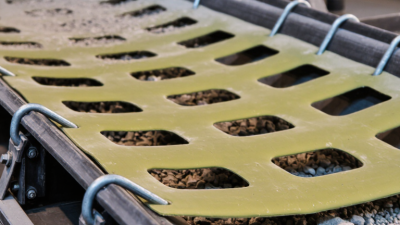
PU screen panels are modular screening surfaces made from cast polyurethane. Their molded openings let smaller particles pass while larger material travels across the deck. Think of them as durable sieves. A vibrating screen moves the feed over each panel, and repeated impacts help separate material by size.
The panel’s flexibility can absorb some impact and reduce noise compared with rigid metal surfaces. Its wear life depends on the material, moisture, particle shape, and operating conditions. Abrasive feed may wear the openings unevenly; damp material can also cause blinding. PU is useful, but not magic.
Choosing a panel involves more than matching an aperture size. Open area, panel thickness, hardness, fastening style, and deck layout all affect screening performance. A smaller opening may improve separation but reduce throughput. That trade-off matters. Inspect panels for rounded apertures, cracks, loose edges, and blocked openings. Measurements from the actual process are more reliable than assumptions based only on a product description. Even a well-chosen panel may need adjustment when feed conditions change.
When comparing Chinese PU screen panel manufacturers, look beyond price and advertised service life. Grand View Research estimated the global mining equipment market at USD 135.5 billion in 2023, with a 5.1% projected annual growth rate from 2024 to 2030. This broad market figure is not PU-panel-specific, but it signals continuing demand for dependable screening equipment. Ask suppliers for documented test methods, not just claims such as “high wear resistance.” Compare polyurethane hardness, tensile and tear strength, abrasion results, aperture dimensions, and panel thickness against your actual feed size and operating conditions.
Fit matters. A panel that is slightly warped or poorly matched to the deck can leave gaps, loosen under vibration, or reduce screening efficiency. Request dimensional tolerances, batch traceability, quality-control records, and sample panels before a large order. For material comparisons, ask whether abrasion testing follows a stated method, such as ISO 4649, and whether results come from an independent laboratory. Test conditions vary; one number alone may mislead. Also check installation support, production capacity, lead time, and how the manufacturer handles failed batches.
Tips: Send suppliers the same feed description, deck dimensions, and operating details. Compare written quotations side by side. Ask for one customer reference with similar material and screening conditions. Then verify the details.
| Evaluation Criterion | Suggested Weight | Comparable Data to Request | How to Verify | Why It Matters |
|---|---|---|---|---|
| Wear resistance | 18% | Test method, specimen details, test conditions, and measured abrasion or wear result for the offered PU formulation. | Request the full test report and compare samples tested using the same method and conditions. Do not compare results from different test methods as if they were equivalent. | Wear performance affects panel service life, replacement frequency, and operating cost. |
| Aperture size and tolerance | 15% | Nominal aperture dimensions, permitted tolerances, aperture shape, and inspection records for the required panel design. | Check a sample against the approved drawing using suitable measuring equipment; confirm how aperture dimensions are defined and inspected. | Opening consistency affects sizing performance and helps reduce the risk of unsuitable or out-of-spec panels. |
| Open area | 12% | Reported open-area percentage, panel dimensions, aperture layout, and the calculation basis. | Compare the reported percentage with the drawing or a documented calculation for the same panel dimensions and aperture pattern. | Open area influences the available screening area and should be considered alongside aperture size and panel strength. |
| Tensile and tear properties | 10% | Test results and methods for tensile strength, elongation, and tear strength, where applicable to the product specification. | Request test reports that identify the material, specimen preparation, test method, and test conditions. ISO 37 and ISO 34-1 are examples of methods used for rubber materials; confirm suitability with the testing laboratory for the PU product. | These properties help assess resistance to tearing or damage during handling and service. |
| Hardness and material consistency | 10% | Specified hardness scale, target value, allowable range, and batch inspection results. | Check that the scale and test procedure are identified. ISO 7619-1 and ASTM D2240 are examples of durometer hardness methods; results should be compared using the same scale and procedure. | Hardness is one indicator of material formulation and should be evaluated with wear and mechanical test data, not on its own. |
| Panel fit and fastening compatibility | 10% | Panel dimensions, thickness, fastening or support details, connection tolerances, and compatibility with the buyer’s screen deck. | Review dimensioned drawings and verify fit using a sample or documented interface check before ordering production quantities. | Correct fit helps avoid installation issues, premature damage, and unplanned modifications. |
| Resistance to process conditions | 8% | Documented operating limits and test or application data relevant to temperature, moisture, slurry, and process chemicals. | Provide the actual operating conditions to the supplier and request written confirmation supported by relevant test data or documented application experience. | PU performance depends on formulation and service conditions; suitability should be checked for the intended application. |
| Manufacturing and customization capability | 7% | Available molding or fabrication processes, maximum panel dimensions, supported aperture patterns, and sample or prototype process. | Request process details, a drawing review, and a sample made to the proposed specification. | Capability determines whether the supplier can consistently produce the required panel design and dimensions. |
| Quality controls and traceability | 5% | Inspection plan, batch identification, material records, nonconformance process, and applicable quality-management certifications. | Review sample inspection records and verify any claimed certification with the issuing certification body or registry. | Documented controls make it easier to confirm that delivered panels match the agreed specification. |
| Lead time, warranty, and support | 5% | Quoted production and shipping lead times, warranty terms, spare-parts availability, and technical support arrangements. | Obtain written terms covering order quantities, delivery assumptions, warranty scope, and the process for handling claims. | Clear commercial and support terms help buyers plan installation, replacement, and ongoing supply. |
Comparison note: The weights are a suggested buyer evaluation model, not a verified ranking of individual manufacturers. Request comparable documents and test results for each supplier, and assess samples against the same drawings, methods, and service requirements.
China’s PU screen panel sector includes manufacturers with different strengths, from custom molding to high-volume production. These ten profiles describe useful supplier types rather than an independently verified ranking. Buyers should confirm each company’s current equipment, quality records, and delivery capacity before shortlisting.
These are distinct capabilities, not proof of overall superiority.
Ask for dimensional tolerances, material specifications, and inspection records. Request samples that match the intended feed and operating conditions.
A panel that performs well in one plant may wear quickly in another. Fit matters.
Compare quoted service life carefully; estimates depend on feed size, moisture, loading, and maintenance. Some suppliers may provide limited field data, so treat unsupported performance claims cautiously.
Shortlist manufacturers whose technical answers are specific, documented, and consistent.
When comparing ten PU screen panel manufacturers in China, look beyond catalog photos. Their product ranges may include modular panels, tensioned panels, and molded panels with different apertures, thicknesses, and fastening systems. These details affect fit and screening performance. A panel that handles wet, sticky feed well may not suit a dry, abrasive application.
Industries served often include mining, aggregates, coal processing, and construction materials. Ask what feed sizes and operating conditions a supplier regularly supports. For example, a quarry using a vibrating screen may need panels that resist abrasion while keeping near-size stones from blinding the openings. Useful capabilities include custom dimensions, aperture options, sample testing, and consistent production quality. Ask how the supplier checks hardness and dimensions, not just whether it offers customization.
Compare technical support and delivery terms, too. Clear installation guidance can prevent panels from being fitted too tightly or left uneven, both of which may shorten service life. Request test data for conditions close to yours, and confirm how replacement panels match existing screen decks. A limitation remains: published wear-life claims are difficult to compare without shared test conditions. Product tables help, but field results still vary. Sometimes, the best choice needs a trial.
When comparing PU screen panel manufacturers, a ranking can be a starting point, not a selection method. Match the panel to your material, moisture level, particle size, and screening equipment. A fine, damp feed may need different openings and panel flexibility than dry, coarse stone. Share these operating details before asking for a quotation.
Check the practical specifications. Ask about panel dimensions, aperture shape, hardness, fastening style, and expected wear life under similar conditions. A reliable manufacturer should explain how these choices affect throughput and blinding, rather than offering one panel for every job. Small details matter. Confirm that drawings, samples, and production panels use the same measurements. Otherwise, a “matching” panel may not fit your deck.
Ask for quality checks, material traceability, and references from applications similar to yours. If possible, run a trial and record throughput, wear, and cleaning frequency. One test can mislead; feed conditions change. Compare lead times, replacement availability, and technical support alongside price. The cheapest quote may cost more if panels need frequent replacement. Still, no specification sheet captures every site condition, so leave room to adjust after real-world testing.